Spaces
The AI software factory for your team. Specs go in, reviewed and tested pull requests come out.
Try it at spacesos.dev
Spaces is a source-available software factory. Every feature moves down an
assembly line of specialised agents — research → specify → plan → tasks →
implement → review → verify → deliver — that know your codebase, your team's
conventions and the tickets behind the work. Humans sign off at the gates that
matter; the factory does the rest.
| Raw material in | A Jira or Linear ticket, a Confluence page, a GitHub issue or an idea in plain words |
| The line | One agent per station, human gates after specify, plan, tasks, implement and verify, and loops that fix until green, review until approved and deliver until merged |
| Finished goods out | A branch and a Conventional-Commits PR per workstream: CI green, code reviewed, QA done, spec committed with the code, then merged and deployed |
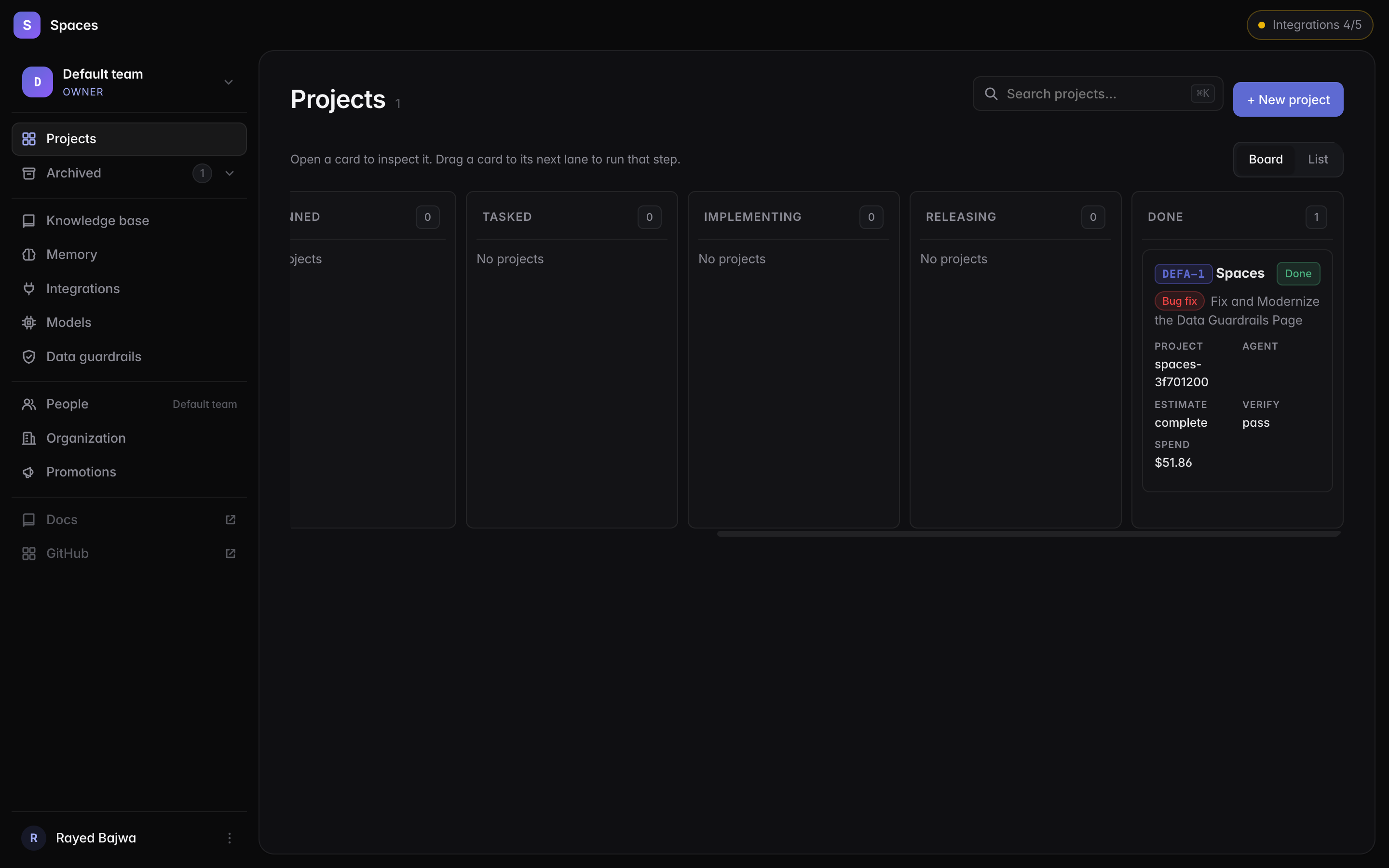
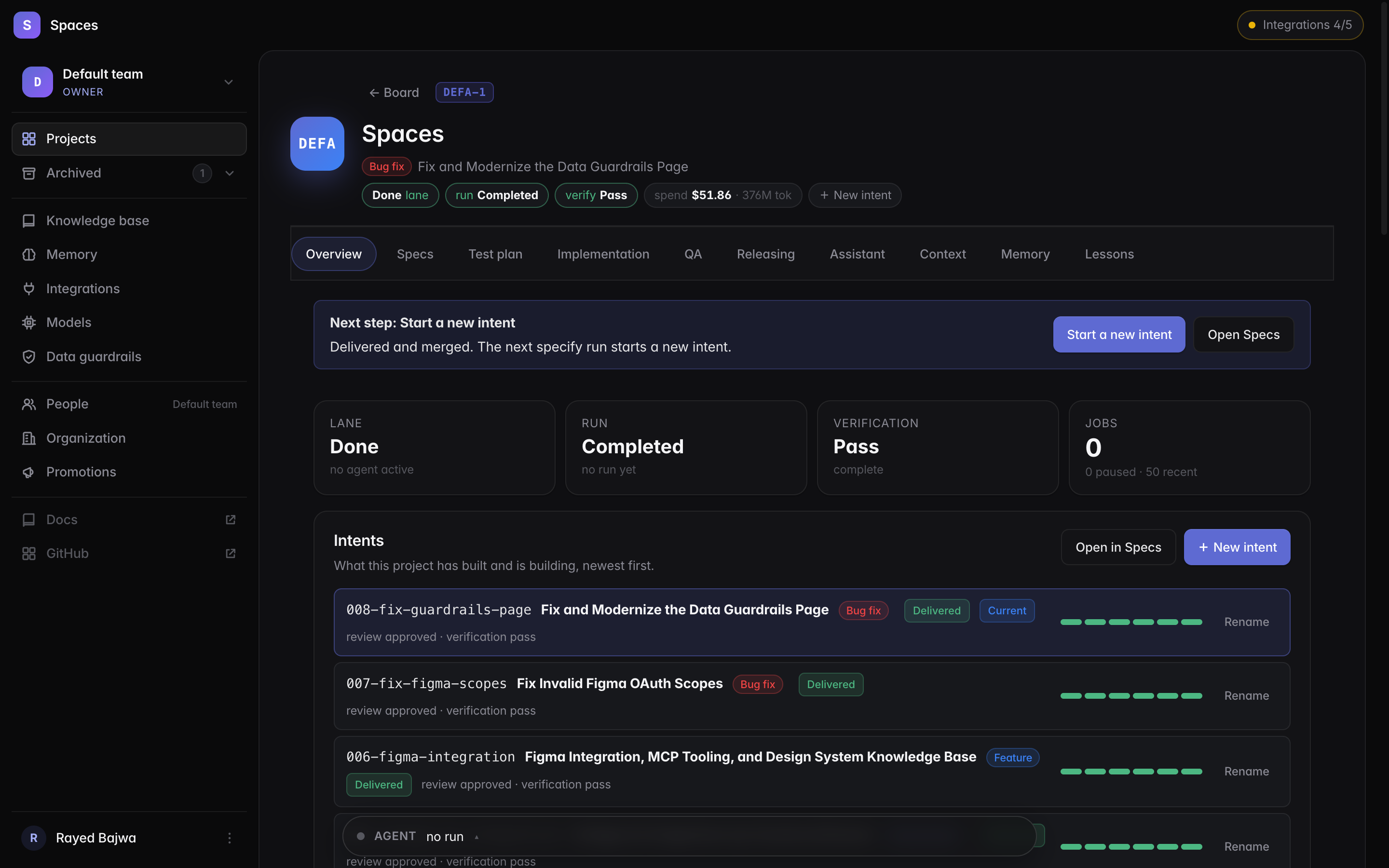
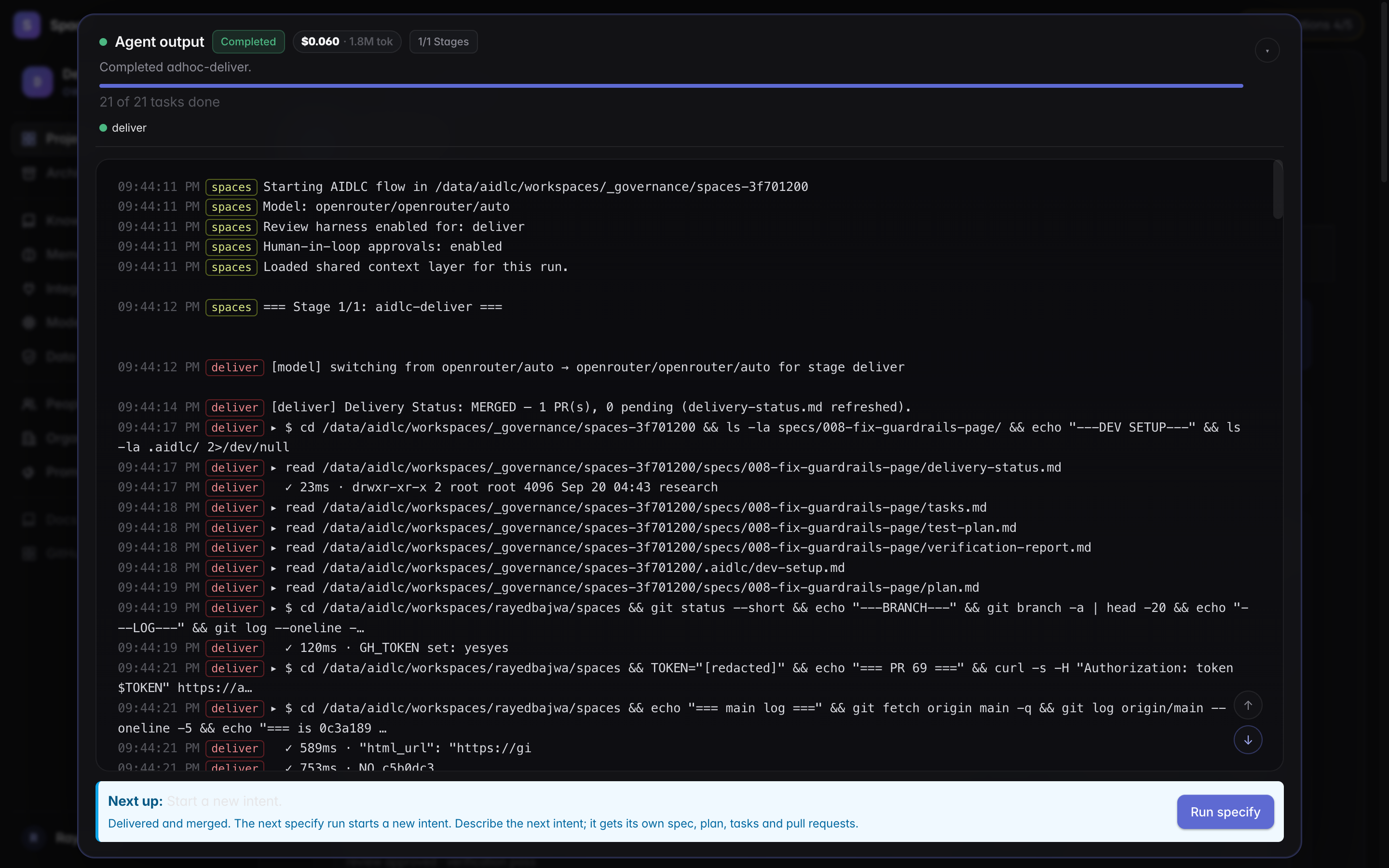
A web UI shows the whole floor — a board where every card is a feature on the line, live agent output and the artifact each station leaves — with integrations for GitHub, Jira, Confluence, Linear and Slack set up in the app.
Stages run on GitHub's Spec Kit (through
@the-agency/pi-spec-kit)
and the Pi Coding Agent SDK.
The pipeline follows the ideas of AWS's
AI-Driven Development Life Cycle
(AIDLC), not its workflow files.
What it does
-
Pipelines as templates
Declarative YAML: stages, roles, per-stage models, human gates, branch conditions and loops (fix-until-green, review-until-approved, deliver-until-merged). See Pipelines & stages.
-
A governing workspace per project
Specs, plans, tasks, reports and memory live in a dedicated local git repo; code repositories are cloned on demand from your GitHub catalog when the plan names them. See Projects & governing workspace.
-
Agents that act, not advise
Agents set up the dev environment, run builds and tests, fix lint and CI, open pull requests, review code and ask for approval only before merging or deploying. See Agents, workers & context.
-
Integrations as knowledge
Jira, Confluence, Linear and GitHub are exposed to agents as scoped tools, tickets can be imported as the starting point of a feature, and whole spaces, projects, initiatives, repositories, web pages and notes can be imported into an organization knowledge base with semantic search. See Integrations as knowledge.
-
Self-serve setup, isolated per organization
Provider keys, OAuth app credentials, model routing, memory, the knowledge base and teams are managed on the organization page; each team has a page for members, invites, memory and knowledge defaults. An organization is the tenant boundary: two of them share nothing. See Organizations, teams & access.
-
Automatic model routing
No model is named anywhere: for the provider in use the catalog is scored by cost and speed into small / medium / large tiers, tuned by an organization policy; with OpenRouter, OpenRouter routes each request. See Configuration.
-
Research before specify, changes committed with the code
A
researchstage clones and learns the repositories a feature needs and loads the knowledge base before anything is specified; each implementation repository then carriesspecs/<NNN-intent>/with its change, tasks and delta spec on the same pull request. See Pipelines & stages and Delivery. -
Delivery, end to end
Every workstream gets a branch and a Conventional-Commits PR (stacked when dependent); the
reviewanddeliverstages drive CI, review, merge, deploy and UAT. See Delivery. -
Intents, recorded
Each piece of work (bug fix, feature, MVP…) is an intent with a scope, its documents and every status change kept in the database; open one to page through everything it produced and its history. See Intents.
-
Secrets and personal data kept from models
Keys, passwords, connection strings, emails, phone numbers and card numbers become tokens before anything reaches a model, and real values are put back only in the commands and files agents write. See Data guardrails.
-
Logs you can follow
Every tool call an agent (or sub-agent) makes is a line in the log, stamped with the time and the agent's name. See Agents, workers & context.
-
Resilient runs
Worker restarts re-queue or pause runs instead of failing them, transient provider errors retry, and reruns resume the previous agent session. See Running & troubleshooting.
Who is this for?
- Engineering leads who want AI to run the boilerplate steps of feature delivery while keeping review gates where they matter.
- Solo developers and small teams who want an agentic workflow that spans several projects and repositories and remembers prior context.
- Anyone experimenting with agentic SDLC patterns who wants a runnable reference implementation backed by Postgres, a job queue and a project board.
Spaces is not a code generator you fire and forget. It is a production line with inspection points: explicit gates between stations, and an artifact you can read, approve or send back at each one.
Ready? Continue with Getting started.