Data guardrails
Secrets and personal data are kept away from AI models. Before anything reaches a provider, each value is swapped for a stable token; the model works with the tokens, and the real value is put back only where an agent needs it.
What is detected
| Kind | Examples |
|---|---|
| Secrets | API keys and tokens (GitHub, OpenAI/OpenRouter/Anthropic, Slack, AWS), JWTs, private key blocks, passwords in connection strings of any scheme (postgres://user:<pw>@…, redis://:<pw>@…), secret query parameters, NAME=value where the name says it is secret (*_TOKEN, *_SECRET, *PASSWORD*, *_KEY, PASS, PWD, CREDENTIALS, AUTH), password: … in YAML/JSON |
| Personal data | email addresses, phone numbers, SSNs, card numbers (Luhn-checked), IBANs (checksum-checked) |
Code stays readable: password = req.body.password or token: string is not
a secret; BYPASS or author is not a secret name; git remotes, no-reply
addresses, versions, dates and UUIDs are not personal data.
How it works
- Tokens. Each value becomes
<EMAIL_1>,<PHONE_2>,<SECRET_3>and so on, the same token for the same value throughout a run. - Every request is masked. The system prompt (project context files included), each stage prompt and shared context, every tool result (file reads, command output) and the history are masked. Tool results and prompts are masked as they enter the history, so compaction summaries and resumed sessions never see real values either.
- Real values only where they are needed. When the model calls a tool that
stays on the machine (the shell and the file tools:
bash,read,write,edit,grep,find,ls), the tokens in its arguments are replaced with the real values, so the file it writes or the command it runs still works:export DATABASE_URL=<SECRET_1>runs with the real URL, and the provider never sees it. Tools that send their arguments out of Spaces (web fetch and search, the browser, knowledge and integration tools, Slack) keep the tokens. - Secret files. Everything read from
.env*(not.example/.sample/.template), private keys,.pgpass,.npmrc,.netrc,.git-credentials,credentials*and*secret(s).*is treated as secret, inNAME=value, INI, YAML, JSON and.pgpasslayouts. Source files such assecrets.tsare code, not secret files. - Resumed runs keep their tokens: each run's vault is stored sealed with
ENCRYPTION_KEY(run_guard_vaults). A vault that cannot be read stops the resumed run rather than leaving tokens unmapped. - Assistant replies show your own personal data back to you; secrets stay tokens.
What leaves Spaces
In Mask and Strict, these are masked one way ([email], [redacted])
whatever an agent wrote:
- run logs, a whole line at a time so a value split across streamed chunks is still caught;
- Slack posts;
- pull request titles, bodies and review/verification comments;
- stage handoff summaries;
- knowledge-base embeddings (documents and queries alike).
In Warn and Off they are sent as written, except that secrets are always masked in run logs, pull request bodies and comments, handoff summaries and embeddings, whatever the setting. Personal data is left as it is in those two modes.
Settings
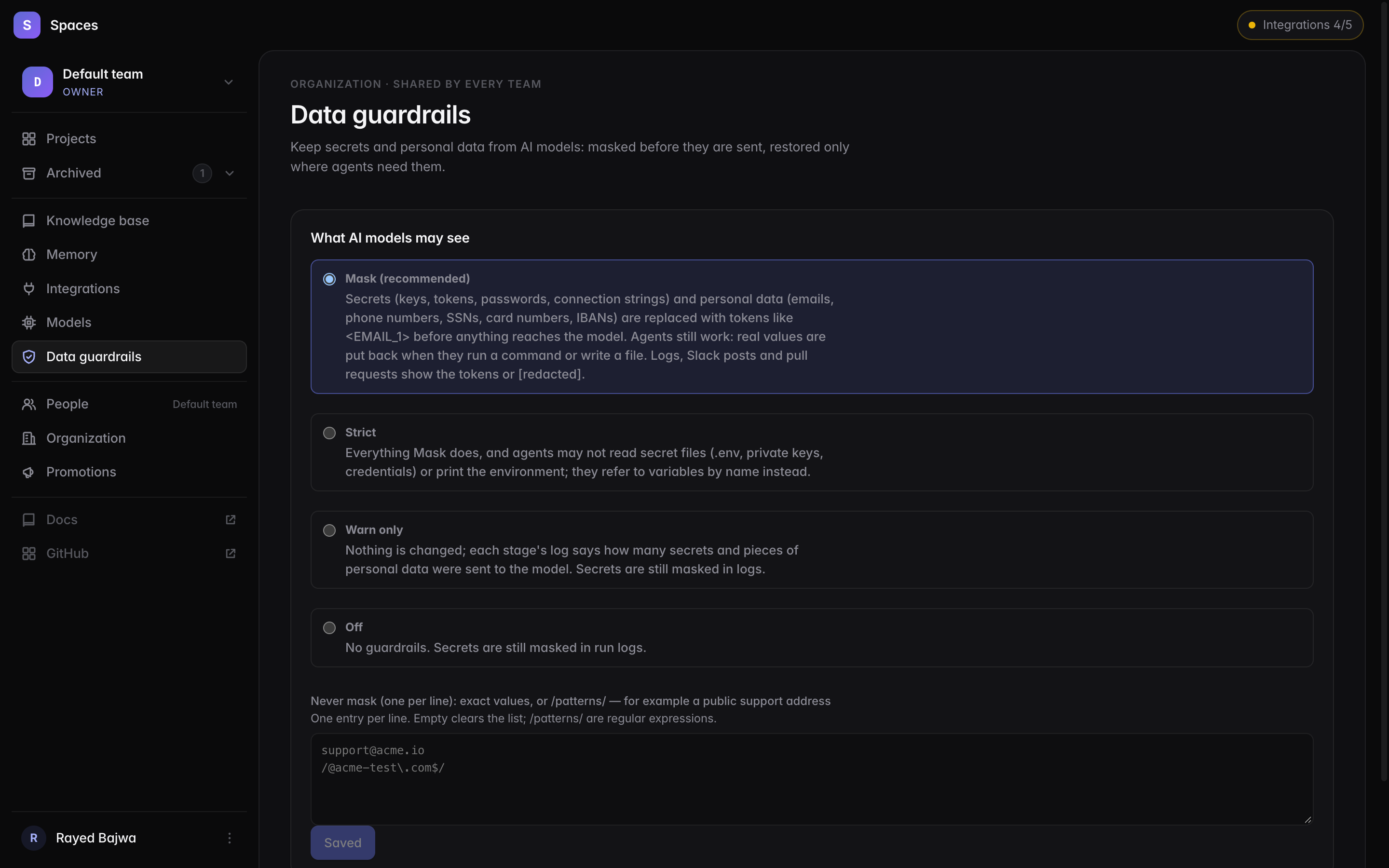
Organization → Data guardrails (owners and admins change it):
| Mode | Behaviour |
|---|---|
| Mask (default) | Everything above |
| Strict | Mask, and agents may not read secret files or print the environment (printenv, env alone, export -p, declare -x, /proc/*/environ); they refer to variables by name instead. env NAME=value command is allowed |
| Warn | Nothing is changed; each stage's log counts what was sent |
| Off | No guardrails (secrets are still masked in run logs) |
Never mask takes exact values or /patterns/ (for example a public support
address); allowlisted values stay, in secret files too.
Each stage's log says what was kept from the model, for example
[guardrails] 2 secrets, 1 email kept from the model; 1 tool call blocked.
The setting is GET/PUT /api/org/guardrails (see the HTTP API).
Separately: agents never see Spaces' own secrets
Independent of the guardrails, an agent's shell does not carry the
application's own DATABASE_URL (or its variants), PG*, ENCRYPTION_KEY,
SESSION_SECRET, Railway tokens or any *_API_KEY / *_SECRET: they are unset
before every command. A checkout's commands use its own .env, which points at
the test database assigned to it. See
Agents, workers & context.